
Paver Patios vs. Concrete vs. Decks: A Cost & Value Comparison
When you decide to create a new outdoor living space, your first big question is: "What do I build it out of?" The three most popular choices—pavers, concrete, and wood decks—all have very different costs, maintenance needs, and long-term value.
Choosing the right material is the biggest decision you'll make, and it depends on your budget, your property, and your goals. As professional hardscape installers, we want you to have a clear, honest look at all the options.
This comparison is a key part of our Ultimate Hardscape Planning Guide, which we created to help you make a confident, informed investment.
Paver Patios
Paver patios are built using individual, interlocking stones. They are our specialty and, in our professional opinion, offer the best long-term value for most homeowners.
Pros:
Unmatched Durability: Pavers are incredibly strong and flexible. Because they are individual pieces, they can move and flex with the ground's freeze-thaw cycles without cracking.
Low Maintenance & Repairable: If a paver gets stained or damaged, you can simply pull that single paver out and replace it. If a section settles over time (due to an underground issue), it can be pulled up and re-leveled.
Stunning Aesthetics: They offer limitless design, color, and texture combinations that concrete simply can't match.
Highest ROI: A well-installed paver patio adds significant, lasting value to your home.
Cons:
Higher Upfront Cost: This is the main one. A paver patio requires deep excavation and a proper gravel base, making it a more significant upfront investment than concrete.
Risk of Weeds: If not installed correctly (with proper edging and jointing sand), weeds can pop up in the joints over time.
Best For: Homeowners who want a beautiful, low-maintenance, lifetime-lasting patio and see it as a long-term investment.
Poured Concrete Patios
This is the traditional, one-piece "builder-grade" option. A concrete slab is poured into a frame and finished on-site.
Pros:
Lower Upfront Cost: Poured concrete is almost always the cheapest option upfront.
Design Versatility (Stamped): You can have concrete "stamped" with patterns to mimic stone or brick, offering some design flexibility.
Cons:
It Will Crack. This is not a question of if, but when. Virginia's clay soil and freeze-thaw cycles are brutal on concrete slabs. A control joint might tell it where to crack, but it will crack.
Impossible to Repair: You cannot repair a crack. Patching looks terrible and is only a temporary fix. If a section sinks, you can't fix it. Your only real option is to live with it or pay to have the entire slab demolished and re-poured.
Color Fades: Stamped concrete color is often topical and will fade significantly from UV exposure over the years.
Best For: Homeowners on a very tight budget who need a hard surface and are willing to accept the risk of cracking and future replacement.
Wood or Composite Decks
Decks are a great option, especially for sloped yards or homes with a raised foundation, where a patio wouldn't be practical.
Pros:
Best for Slopes: Decks are the perfect solution for uneven terrain or second-story exits, as they don't require re-grading the entire yard.
The "Raised" Feel: Many people enjoy the feeling of being on a raised platform, which can be great for views.
Cons:
Constant, High Maintenance (Wood): A traditional wood deck must be stained or sealed every 2-3 years, without fail. If you skip it, the wood will rot, splinter, and warp.
Very High Cost (Composite): To avoid the maintenance of wood, you can use composite decking. However, this is now the most expensive option, often costing 2-3 times as much as a paver patio.
Limited Lifespan: Even a well-maintained wood deck has a 15-20 year lifespan. Pavers last 50+ years.
Best For: Homes on a steep slope, or for homeowners who need a second-story exit and have a larger budget for composite materials.
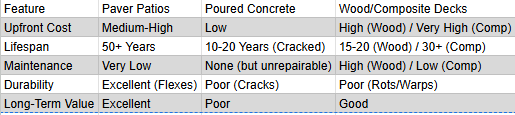
Our Professional Recommendation
For homes in Central Virginia, a professionally-installed paver patio almost always offers the best return on your investment.
While the upfront cost is higher than concrete, the fact that it will not crack and can be easily repaired makes it the clear long-term winner. You are paying for a permanent, low-maintenance solution instead of a temporary one that will need to be replaced.
If you're ready to explore paver options for your home, we'd love to help.